I Was at Teotihuacan When It Happened. WhatsApp Could Have Changed Everything.
A first-hand account of the Teotihuacan terror attack — and how WhatsApp Crisis Communication from msg2ai could have replaced two hours of chaos with coordinated, multilingual response in under 30 seconds.
•5 min read
It was just after 11 AM local time. I was at the entrance of the park, near the Pyramid of the Sun, when the first screams cut through the morning air. The attack — I'd later learn — was unfolding near the Pyramid of the Moon at the far north end of the Avenue of the Dead. Roughly 700 meters away. Close enough to hear the chaos echo down the avenue. Far enough that, by sheer luck, I was on the safe side of it. Within seconds, thousands of tourists — families, school groups, international visitors — were running in every direction. Nobody knew what was happening. Nobody told us what to do. And for the next two hours, we were on our own.
What Happened at Teotihuacan
Teotihuacan is one of Mexico's most iconic archaeological sites — the Pyramid of the Sun, the Pyramid of the Moon, the Avenue of the Dead. On any given day, thousands of visitors walk these ancient grounds. It's a UNESCO World Heritage Site that draws over 1.3 million visitors a year. Tourists feel safe here. I felt safe here.
That changed in an instant. A terror attack struck the park during peak visiting hours. The details are still unfolding, but what I experienced firsthand was the complete absence of coordinated communication during and after the incident. No one knew what was happening. No one knew where to go. No one knew if it was over.
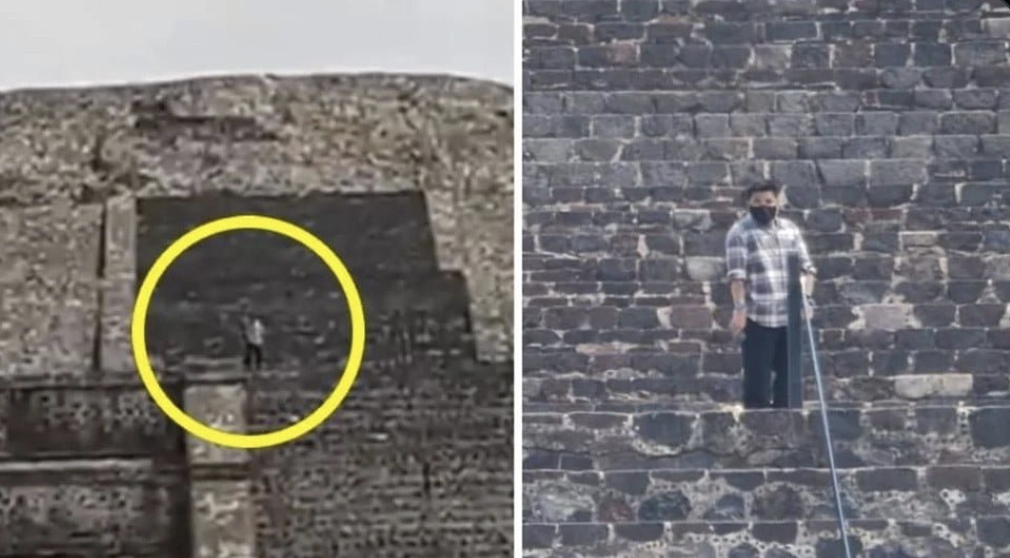
Image circulating in the immediate aftermath of the incident, said to show the suspect on the steps of the pyramid.
"People were frozen. Some were running toward the exits. Others were crouching behind the stone walls of the Avenue of the Dead. We had no information — just fear, rumors, and the sound of chaos echoing off 2,000-year-old pyramids."
Context: The Avenue of the Dead stretches for over 2 kilometers. When panic hits, there are no PA systems, no cellular alerts, no coordinated way to reach everyone.
The Communication Black Hole
In the aftermath, I kept replaying those first minutes. What struck me most wasn't the attack itself — it was the information vacuum. Here's what we didn't have:
📢
No Emergency Broadcast
There was no PA system, no siren, no official announcement. The site is 83 square kilometers of open-air ruins. Voices don't carry.
📱
No Real-Time Updates
Cellular networks were jammed within minutes. No SMS alerts. No social media updates from authorities. Just silence and rumors spreading through crowds.
❓
No Answers to Questions
"Is it over?" "Should we stay or leave?" "Where is it safe?" Hundreds of people asking the same questions with no one to answer them.
📋
No Safety Check-Ins
No way to report you're safe. No way for authorities to know who's accounted for. Families outside the park had no idea if their loved ones were okay.
For two hours, we were left to figure it out on our own. Some people left through unmarked exits. Others stayed put, not knowing if leaving was more dangerous than staying. A few shared WhatsApp voice notes with family — the only communication channel that partially worked on the congested network.
That's when it hit me: WhatsApp was the only thing that worked. Not official channels. Not email. Not SMS. WhatsApp.
What msg2ai's WhatsApp Crisis Communication Would Have Changed
Imagine if Teotihuacan had deployed a WhatsApp-based crisis communication system before that day. Here's what the experience would have looked like — not speculation, but a platform that already exists and is already running at live events.
11:00
Attack Detected
The incident begins. Park security triggers the crisis protocol via the msg2ai dashboard. The system immediately targets all visitors who opted in via the park's WhatsApp QR code at entry.
11:00:15
Emergency Broadcast Sent
"SECURITY ALERT at Teotihuacan. An incident is active near the Pyramid of the Moon. Move AWAY from the northern plaza. Head south along the Avenue of the Dead toward Gate 2 or Gate 3. Do NOT run. Stay calm." — delivered in English, Spanish, and French simultaneously.
11:00:30
Zone-Specific Messages
Visitors near the Pyramid of the Moon get evacuation instructions. Visitors at the Pyramid of the Sun, ~700m south, get a "shelter and hold" message and a different exit route. Staff receive separate command-post directions. No one gets generic "be careful" — everyone gets actionable guidance.
11:01
Safety Check-In
Quick reply buttons: "I'm SAFE" / "I Need HELP" / "I'm with a group of ___". 60% respond within 2 minutes. Those who reply "HELP" are auto-forwarded to emergency coordinators with their location data.
11:02
AI Handles the Flood of Questions
"Where is the nearest exit?" "Is it safe near the parking lot?" "I lost my child near the Moon Pyramid." — 200+ simultaneous questions answered by AI grounded in the park's actual map, emergency routes, and procedures. In the visitor's language.
11:10
No-Response Sweep
Visitors who haven't responded are flagged. A list is generated for physical sweep teams: last known zone, language, group size. Nobody is left unaccounted for.
11:30
All-Clear and Reunification
"ALL CLEAR at Teotihuacan. The situation is resolved. Reunification point: Visitor Center, Gate 1. If you separated from your group, reply FAMILY for assistance." Complete audit trail exported for authorities.
Why WhatsApp Works When Everything Else Fails
During the Teotihuacan incident, regular cellular networks were jammed. Calls didn't connect. SMS queued for minutes or never arrived. But WhatsApp messages — lightweight, data-based, optimized for low bandwidth — still got through. That's not a coincidence. That's how WhatsApp was built.
✓
98% open rate — people check WhatsApp before any other app, especially in emergencies
✓
Works on congested networks — designed for low-bandwidth, 2G connections
✓
8 languages simultaneously — every visitor gets the alert in their language
✓
Two-way conversation — not just broadcast, but AI-powered answers to panicked questions
✓
Under 30 seconds to reach 10,000+ people with actionable instructions
✓
Complete audit trail — every message, response, and timestamp logged for authorities
Why WhatsApp: When cellular networks jam, WhatsApp's lightweight, data-based protocol still delivers. That's why it became the de facto communication channel during the Teotihuacan incident — but without coordination, it was just noise.
This Isn't Just About Archaeological Parks
What happened at Teotihuacan could happen at any major tourist site, outdoor venue, festival, or public gathering. The communication gap is the same everywhere:
1
Outdoor Heritage Sites
Machu Picchu, Petra, Colosseum, Angkor Wat — vast open sites with thousands of international visitors and zero emergency infrastructure.
2
Music Festivals
Large outdoor crowds, multiple stages, international attendees. When something goes wrong, organizers need to reach everyone in seconds, not hours.
3
Sports Events
Stadiums, marathons, open-water swims. Mass participation events where PA systems can't reach everyone and cellular networks are always congested.
4
Conferences & Expos
Large convention centers with thousands of attendees across multiple halls. Fire, security threat, or medical emergency — the communication challenge is identical.
How It Works
The system is simple from the visitor's perspective. They scan a QR code at the entrance, send a WhatsApp message, and they're enrolled. If an emergency happens, they get an alert instantly — no app to download, no account to create.
1
Enroll at Entry
Visitor scans QR code at the entrance. One WhatsApp message opts them in. No app download. Works on any phone.
2
Instant Broadcast
Crisis triggered → pre-approved template sent in the visitor's language in under 30 seconds. Zone-specific routing.
3
AI Responds
Quick replies for check-ins. AI answers questions from park maps and emergency procedures. "HELP" escalates to human coordinators.
The Numbers Don't Lie
98%
WhatsApp Open Rate
vs. 20% email, 45% SMS
<30s
Time to Notify
10,000+ visitors simultaneously
500+
AI Conversations
Real-time, multi-language
8
Languages
Auto-detected per visitor
80%
Cost Reduction
vs. call center staffing
100%
Audit Trail
Every message timestamped
I was there. I felt the panic, the confusion, the helplessness of not knowing. Teotihuacan is not the first place where crisis communication failed, and it won't be the last — unless we change the approach. WhatsApp Crisis Communication from msg2ai isn't a theoretical solution. It's a deployed, working platform that turns chaos into coordinated response. The next site that gets hit doesn't have to go through what we went through.
Don't Wait for the Next Incident
98% reach. Under 30 seconds. 500+ simultaneous AI conversations. One platform that turns chaos into coordinated response.